An inspector sets a small plastic canister in the corner of a basement, checks that the windows are shut, and leaves it there for two to four days while the rest of the inspection carries on upstairs. In Iowa City, that step is close to automatic. It happens on ranch houses in Coralville-adjacent subdivisions and it happens in stone-foundation cottages on the Northside. Nobody negotiates it away, because everybody already knows what the reading is likely to say.
This year, Iowa passed a law meant to change that story for future homes. If you're buying in Iowa City right now, the honest answer is that the law almost certainly does not apply to the house on your list. Understanding why is the difference between reading a headline and reading your contract correctly.
What the New Law Actually Does
House File 2297 passed the Iowa House 87 to 4 and the Senate 46 to 0, was signed by the governor on May 19, 2026, and took effect July 1, 2026. It requires the state building code commissioner to add a requirement to the state building code: new single-family and two-family homes must include a passive radon mitigation method, built to the specifications in Appendix AF of the 2021 International Residential Code. You can read the bill text on the Iowa Legislature's site.
The bill's sponsors framed it as a cancer-prevention measure tied to Iowa's radon exposure, and Iowa Capital Dispatch's coverage of the House vote captured the legislative reasoning behind it. The language in the bill itself is specific on one point that matters more than any other for a buyer: the requirement "shall apply only to single-family or two-family residential construction commenced after the adoption of the requirement." It is not retroactive. It does not touch a single existing home.
Iowa City Already Had This Rule
Here's the part that changes how you should read the news if you're shopping in Iowa City specifically. Before HF2297 existed, Iowa City and Johnson County were already among just 11 jurisdictions statewide that required radon-resistant new construction under the older 2017 IRC standard, according to the Iowa HHS radon resources page. Iowa City, North Liberty, and Johnson County as a whole had already adopted the local ordinance years before the legislature caught the rest of the state up.
That means if you're buying new construction in Iowa City this fall, HF2297 changes nothing about your house. It was already built to a radon-resistant standard under the local code. The genuine shift is happening in the parts of Iowa that never had a local ordinance at all, where builders are now retrofitting their standard plans to comply for the first time.
For an Iowa City buyer, the practical takeaway is narrower and more useful: the law that made national and statewide headlines this year was, for this market, mostly a formality. The real gap was never in new construction here. It's in everything built before anyone was writing radon language into code at all.
Where the Gap Actually Lives
Iowa City's housing stock skews old in exactly the neighborhoods that draw buyers who want walkability and character. The Northside, sometimes called Gilbert-Linn, includes homes dating from the 1860s through the 1930s. The Longfellow district grew up in the early 1900s. Goosetown, College Hill, and the other historic and conservation districts follow a similar timeline. None of that construction happened anywhere near a radon-resistant building code, because the code didn't exist yet.
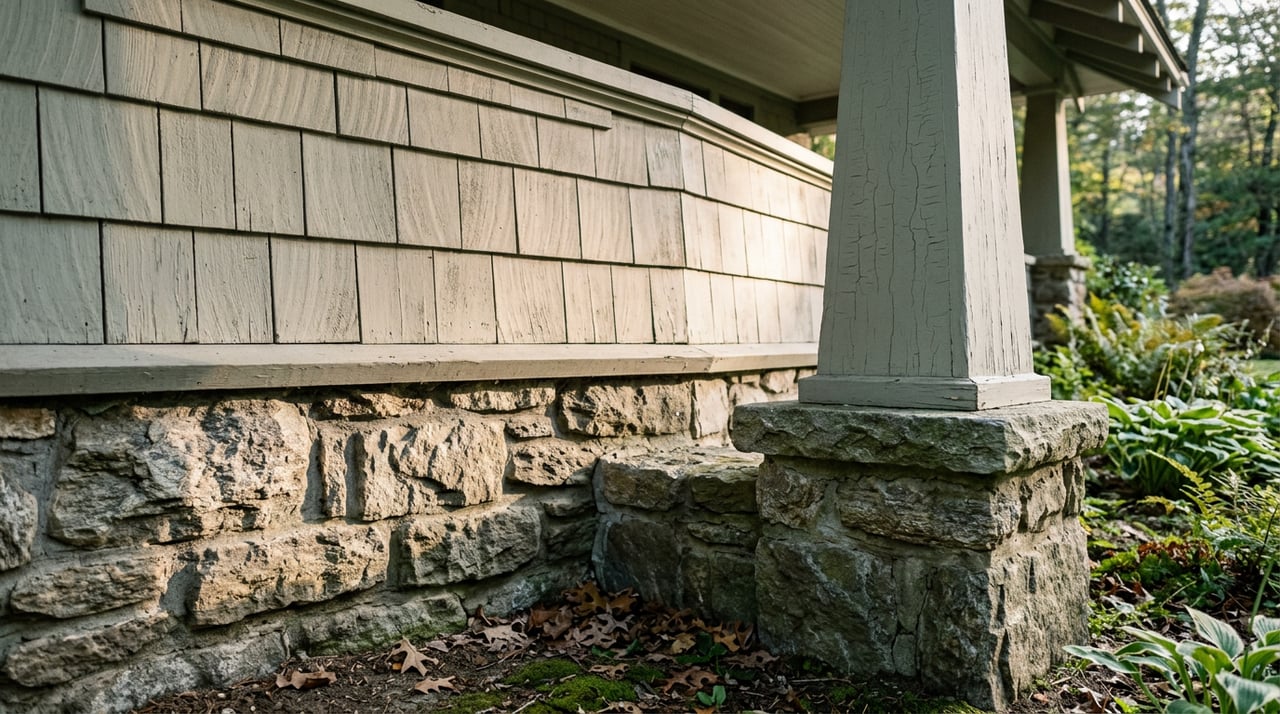
Older foundations compound the problem in a specific way. Stone and block foundations common to that era have more seams, more mortar joints, and more places where a foundation meets a sill plate, and every one of those is a potential entry point for soil gas. A newer poured concrete slab, by contrast, is one continuous surface with far fewer places for gas to find its way in. The Northside Neighborhood Association's own history of the area notes that Northside sits directly north of downtown and adjacent to campus, which is part of why the housing turned over slowly and so much of the original stock survived. That same age is what makes radon testing non-negotiable rather than optional.
Iowa as a whole carries the EPA's Zone 1 designation, its highest radon-potential category, across all 99 counties, Johnson County included. State health officials put the floor at half of Iowa homes testing above the EPA's action level of 4 picocuries per liter, and other public health estimates run considerably higher. The specific number matters less than the pattern: this isn't a risk concentrated in one bad subdivision or one soil type. It's a statewide baseline, and it existed in the Northside and Longfellow decades before anyone in Des Moines drafted a bill about it.
The Cost Math That Makes the Timing Matter
Here's where the new law is genuinely useful context, even though it doesn't apply to your house. Mason City's mayor, speaking in favor of the bill, put a number on the difference between building radon protection in versus adding it later: roughly $300 to $500 to include a passive system during construction, compared to as much as $3,000 to mitigate a completed home, a comparison covered in KTTC's report on the bill's passage. Industry pricing for a standard active sub-slab depressurization system, the kind installed after the fact, typically runs $1,000 to $1,500, with a broader range up to $2,500 depending on foundation type and severity.
That gap is the entire argument for the new law, and it's also the argument for taking your own test seriously if you're buying an older Iowa City home. Nobody built a $400 passive system into a 1920s stone foundation. If your test comes back elevated, you're looking at the retrofit price, not the new-construction price, and that's a number worth knowing before you're three weeks into a purchase agreement instead of during your first walkthrough.
What This Means for Your Offer
Iowa doesn't require a radon test or mitigation as part of a real estate transaction at the state level. What Iowa does require, under Iowa Code chapters 543B.9 and 543B.18 and the rules administered by the Iowa Real Estate Commission, is disclosure: if a seller has had the home tested for radon, they have to tell you the date and the result, and they have to give you a copy of the state's official buyer and seller fact sheet, which you'll acknowledge receiving as part of your paperwork. A seller with no test on file discloses nothing, because there's nothing to disclose. That's the gap a buyer's own contingency has to fill.
A few things worth building into how you approach the inspection period on an Iowa City home:
- Order the test early. Short-term tests take 48 to 96 hours and need a closed-house period to get an accurate reading, so the earlier it starts, the more runway you have to negotiate before your contingency deadline.
- Know where to get one cheaply. Johnson County Public Health sells short-term test kits directly to residents for $12, which is a low-cost way to get a baseline reading even outside a transaction.
- Write the contingency, not just the test, into your contract. A radon result by itself doesn't obligate a seller to do anything. Language that lets you request mitigation, ask for a credit, or walk away if the result comes back above 4 pCi/L is what actually protects you.
- Budget for the age of the house, not the neighborhood's reputation. A well-kept Northside home can still test high. Foundation type and soil conditions vary block to block, and character and radon risk aren't related.
A Few Direct Questions
Does the new law apply to a home that's already for sale? No. HF2297 only applies to single-family and two-family construction that commenced after the requirement took effect on July 1, 2026. Every existing home in Iowa City, regardless of age, falls outside it.
Is radon testing legally required when I buy a home in Iowa? No, but disclosure of any known test results is required by state law, and most Iowa City purchase agreements include a radon testing contingency as standard practice given how common elevated readings are here.
What happens if my test comes back high? A result above the EPA's 4 pCi/L action level typically opens negotiation for the seller to install a mitigation system, credit you for one, or allow you to exit the contract if your agreement includes that language. A properly installed system generally brings levels down substantially within a day of installation.
Buying in Iowa City means buying into a housing stock with real character and, in a lot of cases, real age. That's not a reason to avoid the Northside or Longfellow. It's a reason to make sure your contract does the job the building code was never around to do. If you want a second set of eyes on what your inspection period should include before you're locked into a deadline, Case Group Realty is glad to walk through it with you. Work With Us before you write the offer, not after.